 |
|
|
|
|
|
|
|
|
|
What is an STD/STI/HIV/AIDS & Hepatitis
Sexually Transmitted Disease (STD)/Sexually Transmitted Infection (STI) or Venereal Disease, any of several infectious diseases almost always transmitted through sexual contact.
HIV/AIDS: H - Human - because this virus can only infect human beings. I - Immuno-deficiency - because the effect of the virus is to create a deficiency, a failure to work properly, within the body's immune system. V - Virus - because this organism is a virus, which means one of its characteristics is that it is incapable of reproducing by itself. It reproduces by taking over the machinery of the human cell.
The incidence of STDs/STIs has risen in recent years despite advances in diagnosis and treatment, possibly because of changes in sexual behavior (the SEXUAL REVOLUTION),
“Sexual Revolution, term denoting the sweeping changes in sexual mores in Western societies in the latter half of the 20th century. It ranges from growing social tolerance of divorce, birth control, abortion, and premarital and extramarital sex, to movements for women's liberation and gay rights, to changing perceptions of men's and women's roles in the home and the workplace.”
The emergence of drug-resistant strains, symptomless carriers, lack of public education, and taboos that make patients reluctant to seek treatment.
What is Hepatitis?
The word “hepatitis” means an inflammation or swelling of the liver. Viruses can cause hepatitis. Alcohol, drugs (including prescription medications), or poisons can also cause hepatitis. Another cause can be an opportunistic infection such as Mycobacterium Avium Complex (MAC) or Cytomegalovirus (CMV).
Hepatitis is a very common disease. It can affect people even if their immune systems are healthy. Hepatitis can lead to scarring (cirrhosis) of the liver and liver failure, which can be fatal.
Many cases of hepatitis aren’t treated because people don’t have symptoms, so they don’t know they have hepatitis, or they think they have the flu. The most common symptoms are loss of appetite, fatigue, fever, body aches, nausea and vomiting, and stomach pain. In more serious cases, people may have dark urine, light-color bowel movements, and a yellowing of the skin or of the eyes (jaundice), bloated bellies and wounds that won’t heal.
Hepatitis A and E are both acute diseases. They are spread by contact with fecal matter (aka stool) either directly or through food that was handled by someone with Hep A or E who didn’t wash their hands after going to the bathroom, by contaminated water supply (uncommon in the US, but more common in third world countries), or by sex acts that involve contact of mucosal membranes with the anus (such as rimming). Hep A and Hep E do not cause chronic illness.
Hepatitis B is the most common hepatitis virus. It can be transmitted among family members, through sexual contact, or contact with infected blood. A few people who get hepatitis B develop chronic hepatitis.
Hepatitis C is usually spread by contact with blood or contaminated needles. Hepatitis C can be very mild or show no symptoms, but can cause serious liver damage 10 years after the initial infection. Almost everyone infected with hepatitis C becomes a carrier.
Hepatitis D only shows up in people who get hepatitis B. People who get type D get sicker than people who just have type B.
Hepatitis F: A rare form of liver inflammation caused by infection with the so-called hepatitis F virus, which may be a mutation of hepatitis B. There is no vaccine or treatment for hepatitis F, although anti-viral drugs may be tried.
Hepatitis G is an RNA virus that is very similar to Hepatitis C. However, it has not been associated with any chronic liver disease. In fact, it seems to be a benign virus that is widely present throughout the world. There has been no association between poor outcomes of patients who are infected with Hepatitis C and Hepatitis G at the same time.
|

|
|
Chlamydia Chlamydia is actually a group of different infections caused by different of the Chlamydia bacterium: Chlamydia pneumonia cause a type of walking pneumonia -
Chlamydia psittacine causes a type of pneumonia caused by birds
-
Chlamydia trachomatis causes various sexually transmitted diseases
Chlamydia trachomatis is currently one of the most common and widespread bacterial STDs in the United States. It is estimated that more than 4 million people are infected each year. Rates of Chlamydia in the United State are highest in the West and Midwest, with Missouri having above average numbers.
As many as 1 in 10 adolescent girls tested for Chlamydia is infected.
Chlamydial infection is widespread geographically and highly prevent among these economically disadvantaged young women between 16 and 24 years old.
Symptoms of Chlamydia
Women
Most women are asymptomatic, but if symptoms are present they may be minor. Symptoms may include:
-
vaginal discharge
-
burning sensation during urination
-
If the infection spreads to the fallopian tubes, women may experience:
-
lower abdominal and lower back pain
-
pain during intercourse
-
bleeding between menstrual periods
-
nausea or fever
Men
Men may be asymptomatic or symptoms may be minor. When symptomatic, men may experience one or more of the following:
-
Pus (thick yellow-white fluid) or watery or milky discharge from the penis
-
pain or burning during urination
-
pain or swelling of the testicles
|
|
|
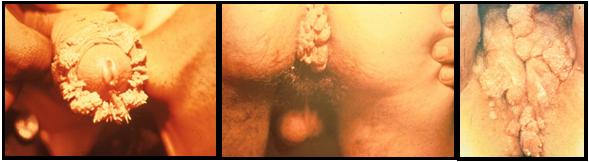
Condyloma Condyloma is also known as: wart, genital wart, venereal wart, and all are caused by a virus called the human papilloma virus.
Wartlike growth on genitals or anus: a growth resembling a wart on the skin or a mucous membrane, usually of the genitals or anus. Genital warts are caused by the Human Papilloma Virus (HPV). Papilloma viruses cause small growths (warts) on the skin and mucous membranes. Infection of the genital and anal regions with HPV can cause warts (ano-genital condyloma) on the penis, vulva, urethra, vagina, cervix, and around the anus (perianal).
More than fifty different types of HPV have been classified. These types are numbered. Several types, including 6 and 11, are associated with raised, rough, easily visible genital warts (especially in women). Other types are associated with flat warts.
The Symptoms Of Condyloma
Genital warts first appear as small pink or red bumps on the vulva (lips of the vagina), vagina, cervix, penis shaft, urinary opening or rectum. They are usually painless, but some people may have itching, burning or slight bleeding from these areas.
The time between exposure to the virus and the appearance of warts is not known. It could be anywhere from several weeks to several years before symptoms occur. Because of this, it is had to tell when and where you were exposed to the virus.
Sometimes vaginal infections and pregnancy can cause warts to grow and spread. One study showed that 20% of women with genital warts also had a vaginal infection. Unless that infection is treated, the warts may not go away.
|

|
|
Gonorrhea
-
an infection that is spread through sexual contact with another person
-
caused by a bacterium, Neisseria gonorrhoeae
-
second only to Chlamydial infections in the number of reported cases.
The Gonorrhea germs are found in the mucous areas of the body:
-
Genital tract
-
Penis
-
Rectum
-
Throat
-
Vagina
Risk Groups:
- Any person who is sexually active can be infected with Gonorrhea
- Common among younger people, ages 15-30, who have multiple sex partners
-
Increases in Gonorrhea have been found among men who have sex with men
-
Occurs more frequently in urban areas than in rural areas
It is the most common reportable sexually transmitted infection in the United States, with an estimated 800,000 cases of Gonorrhea reported annually.
Symptoms Of Gonorrhea
Woman
-
Painful or frequent urination.
-
Anal itching, pain, bleeding, or discharge.
-
Vaginal discharge (with pus).
-
Irritation of the external opening of the vagina (vulva), itching, swelling, redness, and soreness.
-
Heavy menstrual bleeding.
-
Bleeding between menstrual periods.
-
Lower abdominal discomfort.
-
-
Fever, Sore throat (rare).
-
Painful sexual intercourse.
-
Men
- Thick discharge from the penis (clear or milky at first, and then yellow, creamy, and excessive, sometimes blood-tinged).
- Painful or frequent urination.
- Anal itching, pain, bleeding, or discharge.
- Sore throat (rare).
- Infection of the lining of the eyes ( conjunctivitis) (rare).
|

|
|
Herpes Herpes is a sexually transmitted disease (STD) caused by the herpes simplex virus (HSV).
Genital herpes infection is very common and on the increase in the United States. Nationwide 45 million people aged 12 and older (1 out of 5 of the total adolescent and adult population) are infected with HSV-2. It is more common in women (1 out of 4) than in men (1 out of 5) possibly because male to female transmission is more efficient than female to male transmission. HSV-2 infection is also more common in areas of high socio-economic disadvantage, facing fundamental issues of health such as:
Statistics:
-
An estimated 40 million people have genital herpes which is a chronic viral infection
-
About 500,000 new people get symptomatic herpes each year
-
There are even more people without symptoms
The Symptoms Of Herpes
Symptoms of herpes usually develop within 2 to 20 days after contact with the virus, although it could take longer. These symptoms may last up to several weeks, varying from one person to the next. In many people, the first infection is so mild that it goes unnoticed. In others, the first attack causes visible sores. Even so, subsequent recurrences of the disease may cause lesions. When the sores are completely healed, the active phase of infection is over. Healing of the skin usually leaves no scars. In either case, the virus retreats into the nervous system and lies dormant.
The virus starts to multiply when it gets into the skin cells. The skin becomes red and sensitive, and soon afterward, one or more blisters or bumps appear. The blisters first open, and then heal as new skin tissue forms. During a first outbreak, the area is usually painful and may itch, burn or tingle. Flu-like symptoms are also common. These include swollen glands, headache, muscle ache or fever. Herpes may also infect the urethra, and urinating may cause a burning sensation.
|

|
|
Lymphogranuloma Venereum Lymphogranuloma Venereum is an uncommon disease with about 200 reported cases per year.
Incubation period is 5 to 20 days.
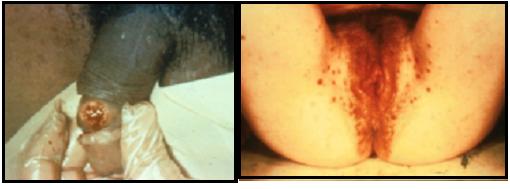
Lesion: Transient vesicles on penis or vagina that are often unnoticed and patients do not usually seek medical advice.
Clinical manifestations: Two to six weeks after the vesicular lesions have healed, inguinal lymphadenopathy appears which leads to the formation of “bubos” (inflamed lymph nodes especially in the groin area) containing the organism. Bubos are bilateral in one third of patients and are very painful. In 25% of cases, the inguinal ligament (Pompart) cleaves the swelling (known as “groove's sign”). The bubos contain infected, purulent material that must be aspirated or they may rupture. The great danger in treatment is inducing a non-healing draining fistula; hence one should aspirate the fluid by piercing the skin through healthy tissue and draining the fluid every 3-4 days. Women do not have involvement of inguinal nodes because the vagina drains towards the perirectal glands. Instead, proctitis and/or rectal fistulas are seen. These may also be seen in individuals who engage in rectal intercourse.
Symptoms of Lymphogranuloma Venereum
The first symptom may be a small, painless pimple or lesion occurring on the penis or vagina. It is often unnoticed. The infection then spreads to the lymph nodes in the groin area and from there to the surrounding tissue. Complications may include inflamed and swollen lymph glands which may drain and bleed.
How soon do symptoms appear?
The onset of symptoms varies widely. The initial leasion may appear from 3 to 30 days after exposure.
When and for how long is a person able to spread LGV?
An individual remains infectious as long as there are active lesions.
|
|
|
Syphilis
Primary Syphilis
The first symptom of primary syphilis is an ulcer called a chancre ("shan-ker"). The chancre can appear within 10 days to 3 months after exposure, but it generally appears within 2 to 6 weeks. Because the chancre may be painless and may occur inside the body, the infected person might not notice it. It usually is found on the part of the body exposed to the infected partner's ulcer, such as the penis, vulva, or vagina. A chancre also can develop on the cervix, tongue, lips, or other parts of the body. The chancre disappears within a few weeks whether or not a person is treated. If not treated during the primary stage, about one-third of people will go on to the chronic stages.
Secondary syphilis
A skin rash, with brown sores about the size of a penny, often marks this chronic stage of syphilis. The rash appears anywhere from 3 to 6 weeks after the chancre appears. While the rash may cover the whole body or appear only in a few areas, it is almost always on the palms of the hands and soles of the feet.
Because active bacteria are present in the sores, any physical contact—sexual or nonsexual—with the broken skin of an infected person may spread the infection at this stage. The rash usually heals within several weeks or months.
Symptoms of Syphilis
The initial infection causes an ulcer at the site of infection. The bacteria, however, move throughout the body, damaging many organs over time. Medical experts describe the course of the disease by dividing it into four stages-primary, secondary, latent, and tertiary (late). An infected person who has not been treated may infect others during the first two stages, which usually last 1 to 2 years.
In its late stages, untreated syphilis, although not contagious, can cause serious heart abnormalities, mental disorders, blindness, other neurologic problems, and death.
|
|
|
|
Ecneret Family Services, Inc.
465 West 162nd Street 309 West Park Avenue
South Holland, Illinois 60473 Aurora, Illinois 60506
You may e-mail us at: efsi@ureach.com
Toll Free Phone/Fax: 877.810.6218
|
|
